
Clavel’s Sotol Negroni is Over 4,000 Days Old. But You Can’t Have It Until It’s Ready.
By James Colino
As a teenager, my parents would drag me to Inner Harbor in Baltimore at least once per year. They would walk along the watersedge looking at sail boats. I would peer into the brackish water littered with cigarettes and candy wrappers hoping to catch a glimpse of a crab dismembering a dead fish or something. That was the highlight of my trip.
Over the years, Baltimore became a place I passed by on the way to New York or DC. I never gave a return visit a second thought.
That was almost 20 years ago.
Today, when the topic of visiting Baltimore comes up in conversation, l always hear people say it’s dangerous and not worth visiting.
I’m sure some parts of the city are dangerous. Every city has them. But, last week, I found a vibrant Inner Harbor. I found a city teeming with smart college students. I found a sports town proud of their teams. And best of all, I found a really good reason to return to Baltimore on a regular basis.
That reason is a mezcalería called Clavel.
Typically, Tuesday is a dead zone for most restaurants. And 8pm on a Tuesday is usually cleanup time. So when I pulled up to Clavel and found a parking spot right in front of the building, I was fully expecting to find the bartenders cleaning glasses and the waiters doing sidework.
Outside, the street was quiet. The location wasn’t quite what I expected. It’s not on restaurant row. It’s not in a cute neighborhood. But it’s exactly where I’m used to seeing a restaurant in the Mexican neighborhood where I grew up. In Latino neighborhoods, bars and restaurants are where they are. They’re a destination – not part of a multi-year redevelopment project. It felt like home.
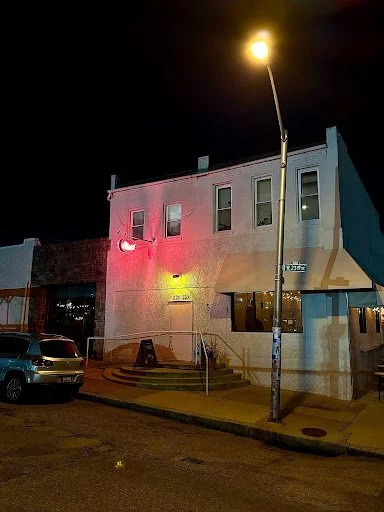
As I got out of my car and snapped a few pictures for my newsletter, I wasn’t sure how to enter the building. I mean, there was a door, but it didn’t look like your typical entrance. I pulled on the handle anyway, expecting it to be locked. Instead, the door swung open to an unexpected buzz of human energy, clanking plates, and familiar Mexican smells.
The place was alive! I barely got both feet past the door frame. My butt was keeping the door from closing. From my tip toes, I could see what looked like a kitchen at the far end of the narrow entrance. To my right, behind a windowed wall, was a bustling dining room filled with a diverse range of customers. There was a trio of women wearing army fatigues, a couple on a first date, a young family of four, and a business meeting in full swing. Everyone looked happy. Except me.
I was about 10 or 12 people deep in line but I could see a hostess leading people past a small, densely crowded bar area. She was good. Clavel doesn’t take reservations so she had to think on the fly, trying to fit each group of customers wherever she could without extending their wait or overwhelming the servers. That can’t be easy.
As I got closer to the front of the line, I could see more of the interior. The space was dimly lit with the glow of rope lights and candles softly illuminating arched doorways and exposed brick walls. I had a clear shot at the busy kitchen now. It was an all-woman kitchen. That made me smile. It reminded me of my childhood. On many weekends, my family would rent dance halls for special events and the women would occupy the kitchen to cook mole, fresh tortillas, homemade beans, and rice.
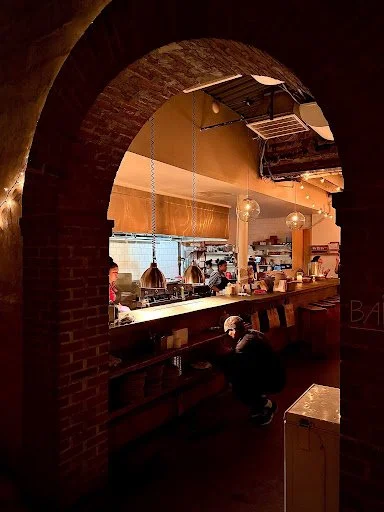
The reason for my visit this day was not to eat though. It was to sip mezcal. I’d heard good things about Clavel from my mezcal community and I routinely see them named as a “Top Mezcalería in the US” in publications that matter. They have a regular weekly tasting event too, bookable through Resy. There were spots available when I looked online the week prior but I got sidetracked and never locked in a date. When I returned to book it, it was sold out.
Undeterred, I decided to roll the dice and just show up. But when I arrived and saw how busy the bar was, I didn’t think I’d be sitting any time soon. Imagine my surprise then, when the hostess dropped her shoulder, wedged her way through the bar crowd, and showed me to a lone stool leaning forward against the underside of the bar.
Sitting down at the bar of proper mezcalería is always a little bit overwhelming for me. My eyes scan the shelves looking at labels, I check out the glassware, I look for a mezcal list, and I watch the bartenders bang out cocktails in the service area.
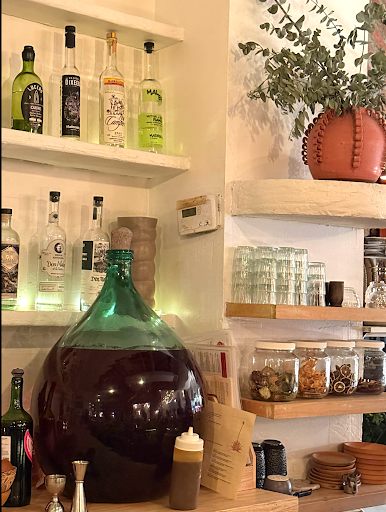
This time, I was intrigued by a large glass demijohn in the corner. It had a dark liquid in it. More on that later.
In the US, most mezcalerías pride themselves on having the largest selection of mezcals to choose from. As such, I expected a huge wall of mezcal at Clavel. Instead, I found what appeared to be a highly-curated display of bottles.
Since I couldn’t join the guided tasting, I decided to design my own journey at the bar. It’s what I normally do anyway. After scanning the mezcal list for far too long, I ignored my usual – start with something sweet and simple – rule. My go-to is typically an ancestral espadín. They’re usually soft and very drinkable. But this time, for some reason, I ordered a Tepextate. It was a rookie mistake. Tepextates can hit your tongue like a lightning bolt if your palate isn’t ready and this one certainly did.
While my eyes were still watering, I vaguely noticed a man making his way down the bar talking to patrons along the way. He seemed to know everyone. When he got to me, he relocated a friendly local who was sitting next to me, pulled up a stool, and starting talking to me mid-sentence as if we were picking up a conversation from five minutes ago.
“I was hungry. I had to eat. So I thought I’d come down and order some tacos. I’m Carlos, by the way.” he said as he shook my hand.
“What have you tried?” he asked.
My face was still numb from the tepa but I managed to tell him about the lightning in my mouth.
“Oh, you have to try a tobalá.” he said. “They’re so smooth.”
Before I could reply, the bartender brought over a skinny bottle of Dixeebe Tobalá.
“This is a 52 but you won’t even know it.” Carlos was referring to the alcohol content.
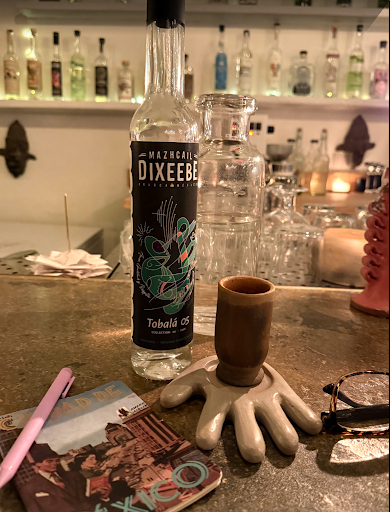
Alongside the bottle, a clay drinking vessel arrived. The surface was rough like the clay pots you find at a palenque. It rested on a coaster shaped like an open palm. To some, it was cute. To me, the pairing was intentional. The cup brought mezcal production into the tasting experience and the palm was a clear symbol of hospitality and inclusion.
As I pondered the level of intentionality I was witnessing, Carlos chimed in, “We have a very intentional agave program here. Our beverage director is the best in the business. If we don’t know the producer personally, chances are, it’s not on our shelves. In many cases, we’ve been to their homes.”
We finished the tobalá just as a plate of tacos arrived in front of Carlos. It dawned on me now. This was Carlos Raba, the chef and partner of Clavel.
“We make our tortillas in-house too. On the other side of this wall is a nixtamalería. We use indigenous corn from co-ops in Mexico. Let’s have another mezcal.”
Carlos grabbed the mezcal menu, running his finger up and down the descriptions. “What would you like to try next?”
As I gave it some thought, he whipped out his phone and started writing a text message to someone. He found a small error on the menu and wasted no time getting it corrected.
“The ABV is wrong on the menu. We’ll need to reprint these. Let’s have a capón.”
As the bartender poured a 5 Sentidos Capón into a pair of veladora glasses, Carlos dipped his fingers into the spirit, rubbed his hands together vigorously, and cupped them around his nose.
“This is the best way to bring out the essence of a mezcal.”
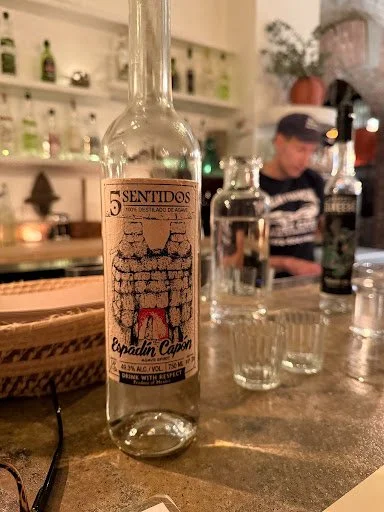
I normally rub mezcal on my wrist, like cologne, but his technique was better. It generated heat and surfaced a broader range of aromas. I took note to adjust my routine.
If you’re from Baltimore, Clavel is nothing new. It’s been a staple on West 23rd Street in the Remington neighborhood for over a decade. Anyone who enjoys mezcal or a modern take on a farm-to-table taqueria has likely been there. So, I had to ask, “You’ve been open for 11 years now. You’ve won awards. A lot of journalists have written about Clavel. What’s something most people wouldn’t know?”
Carlos took a final bite of his final taco and finished his mezcal.
“This will sound really boring. But, we haven’t changed anything here since we opened. I mean, things have changed, of course, but what we’re trying to do here hasn’t. Our overall mission.”
Carlos went on to describe the work they do in local schools working with children, the co-ops where they get their corn, their passion around immigration reform, the family-run mezcal brands they choose to support.
He wasn’t bragging. I could tell it’s what drives him. You don’t last a decade in this business if your heart isn’t in it.
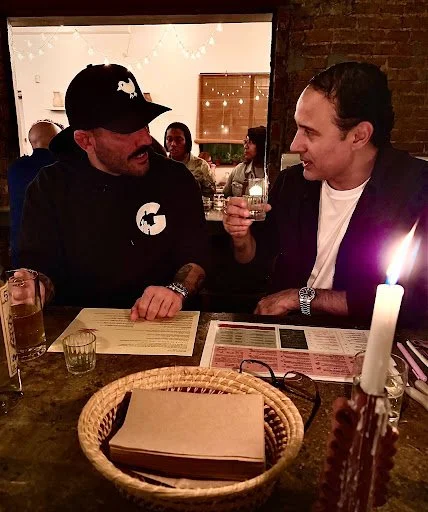
“Let’s have one more. Something interesting. Then I need to go.”
We shared another 5 Sentidos. This time it was a funky tobala expression fermented in cuero. That means it was fermented in animal skin. In this case, a cow hide. It had an earthy, leathery profile. Super smooth.
Before Carlos left, I asked about the dark mystery liquid in the corner of the bar.
“Ah…that’s our sotol negroni. We started it when we opened. When the bottle gets halfway down, we rebuild it. It must be 11 years old by now. But it’s not ready. Come back in two or three weeks!”
I was hoping to get a little sample. But when a chef has quality standards, they don’t make exceptions. It’s ready when it’s ready. Respect.
Coming back to Baltimore was full of pleasant surprises for me. The city surprised me, a lively Tuesday surprised me, and the personal tasting with Carlos was a wonderful surprise.
As I finished jotting down some notes for this article, I realized that I learned a lot about mezcal and the level of detail and intentionality it takes to operate this business at the highest levels for over a decade. It’s these little details that earn return visits in the restaurant and bar industry.
Before I left, I texted a few of my closest mezcal friends to start planning a return visit to Clavel. Next time, I look forward to seeing more of Baltimore, exploring the food menu, and leaning into that 11 year old negroni. Hopefully, I’ll catch it when it’s ready to drink!
—
James Colino is the founder of Mezcal Culture and The Mezcal Download. He holds a Mezcal Certification from the Agave Spirits Institute and can be found visiting mezcalerias across the world, hosting tastings for curious drinkers, and writing original content for mezcal brands. Subscribe to the Mezcal Download
—
Keep IT going…
Every Thursday I send The Mezcal Download — a weekly email with mezcaleria reviews, bottles worth your money, the latest agave news, and the best events coming up this week. Subscribe free
Want more mezcal? Here are some great resources to continue learning…
Decode every term on a mezcal menu: Mezcal Culture glossary.
Find the bars that do it right on our list of the best mezcal bars.
Find the best events. Look up a mezcal or tequila event near you.